I believe I should begin by admitting that discrimination isn't new. One could almost claim that all societies were built upon it, at one time or another. Many people, maybe even most, have faced discrimination at some time in their lives, that isn't new either. There are some, however, that are impacted more often and more strongly by discrimination as a whole. People who are set out by the majority as "other". These people are often feared because of their "other-ness" and that fear can often incite hatred.
While discrimination isn't new, I recently found a medium through which I could analyze a fictional interpretation of the fear tactics and media incitement of discriminatory behavior (and violence) towards a "powerful minority".
In Marvel's Agent's of S.H.I.E.L.D this season, there has been a side story (and occasionally main plot) of discrimination and fear directed at the Inhumans (humans with "abilities" due to a slight difference in genetics). Their approach toward this fear, and subsequent anger and violence, is reflexive of the rhetoric often heard today about Muslims, Blacks, Mexicans, LGBTQ members, and more. It is reflexive of the language used long ago to describe the Jews, the Romany, the Japanese, the Native Americans, etc.
It is true that people fear the unknown, that is why religion is so important to so many people because it explains the unknown and places an imaginary protection around its believers against the evil. In AoS, there is no religion, or it is not the focus of the show when there is, but there is an abundant amount of the unknown. Always has been. It is practically been the main plot device used in the show. Thus, in the show, there is an abundance of fear. This fear needs an outlet and the outlet is anger and discrimination.
The organizations in the SHIELD verse, the Watchdogs and Humans First, which do appear to have a connection, work well to continue the pattern of fear and discrimination that the sheer presence of other, of the unknown, began by just existing. Humans First incites fear by enhancing the beliefs of the other-ness of the Inhumans and creating an "us vs. them" mentality. This is the same mentality that led to the rise of Nazi Germany, lynchings of Blacks in America, Internment Camps, etc. The fear incited is a double-edged sword. On one edge of the sword lies the Watchdogs and the general populace, a main antagonistic group this season and major nuisance/antagonistic group last season. The Watchdogs are a terrorist organization set out to hunt down and kill Inhumans and are willing to go after anyone who aides them. The general public are incited by the rhetoric of the Humans First movement, only their fear turns more often toward discrimination and petty violence (comparatively). However, the general populace has just as much potential for harm against the Inhumans as the Watchdogs do, because they are unpredictable and feel desperate. On the other edge of the sword created by the Humans First movement lies with the Inhumans themselves. They look out at the world every day and they see the news saying that they are monsters, they hear reports of other Inhumans being killed by terrorist organizations, they see the discrimination rampant in their friends, family, and neighbors. Maybe they even begin to fear and hate themselves. Because how can so many people be wrong about them? Maybe the Inhumans are evil and I am just the exception. These influences can cause the Inhumans to either join in the hatred, try to keep their heads down, or become the very thing that incites fear.
Unfortunately, no matter what the Inhumans choose to do, they cannot control the decisions and feelings of the public until the rhetoric of anger and fear is ceased. Look at Yo-Yo. She is an Inhuman and she saved the lives of her friends by disarming the Watchdogs as they were about to execute a trick magician. Unfortunately, instead of reacting with thanks, her friends and the strangers she saved turned on her, pointing her out to the Watchdogs and then throwing her away like trash. The creepy Humans First senator with ties to the Watchdogs summed up the problem with the discriminatory rhetoric in the cross debate scene, "People are scared that Inhumans do not share our core values. And who could blame them?" Her statement summed up the fears of the other-ness of the Inhumans and worked to increase the difference between "regular" humans and Inhumans.
Because there was a required registry of the Inhumans (simply because they are different/other and are seen as dangerous), the Watchdogs were able to track down the Inhumans and kill them. The rhetoric, combined with a preexisting self-hatred and some mental health problems (previous addiction to an age old, practically immortal alien that had power over Inhumans) created a man who hated himself, and others like him, enough that he was willing to sell them out and hand them all a death sentence. While he was not exactly the most stable man before becoming Inhuman, the power of fear-filled rhetoric on the public should not be ignored. History has shown us this. The dangers of registry lists should also be carefully scrutinized, as easy identification of a people also has had disastrous results in the past.
As I watched, the episode "Uprising", the episode that began the descent into the Humans First sub-plot and made the Watchdogs a larger threat than they were before, I was struck with familiarity. The "Inhuman Resistance," which was nothing more than a terrorist group (the Watchdogs) trying to incite negative public opinion on the Inhumans (and kill them). The public and media response where, despite being presented with the facts, they continue to have "a discussion" on the potential dangers of the Inhumans, despite the statistically significant difference in the number of deaths during the Watchdog's EMP attacks (2 humans vs. 17 Inhumans). I sat there watching and I thought of ISIS. I thought of some of the media reactions to Muslims and to Islam. I thought of how the main victims of ISIS are Muslim, how our cruel, uneducated, and insensitive media and political rhetoric is encouraging impressionable or disheartened individuals to join ISIS or commit acts of terror in its name. I thought of the attacks committed against anyone who looks "Muslim" by uneducated, angry, and fearful people. The parallels were appalling.
One person wrote a Facebook comment that they might stop watching the show because of its "political agenda" and that shows should be nothing but "fiction". The truth is, in my opinion, the "political agenda", which has always and will always exist in a show about SHIELD as it is a government agency, enhances the show considerably. It allows viewers to look at the show and see a reflection of reality, see some reflection of their lives and, because this is a fictional show about superheroes and not Supernatural, see the good guys win, even when at times all seems lost. Having AoS portray storylines that reflect reality in some way (and they have several every season, although this season is especially poignant) can give some people hope or further another's understanding of a situation. Some people might stop watching because they want their TV series to be free of "political agendas," but in order for that to happen they had to first recognize the correlation between fiction and reality.
It means that they had to think. And thinking is just a fancy word for changing your mind (yes, I am quoting the Doctor).
The only way that we can combat discrimination and fear and anger is to get people to think, to get people to truly look at the world around them and see that it can be improved. If we have to do that through television shows to get people to actually listen, so be it.
Saturday, October 29, 2016
Thursday, October 13, 2016
When Entertainment and Philosophy Collide!
Under most circumstances I have a lot of trouble watching comedies, whether it be a 90 minute movie or a 30 minute television episode (or anything in the middle). I am too analytical to enjoy a show or movie that is only there to entertain. I normally get annoyed and irritated and either end up skimming the episodes/movies to get the basic plot and a couple of jokes here and there. This is what happened with Psych, the Office, IT Crowd, Angie Tribeca, Raising Hope, Baby Daddy, How I Met Your Mother, (to a lesser degree) The Big Bang Theory, and, unfortunately, Speechless (although I will still watch it because it is a good show). Continually, I would start these comedic shows and within 4 episodes I would be throwing things at the screen/plugging my ears/skipping large portions of the episode to avoid the comedy. The only comedies that I have, until now, been able to watch thoroughly are Parks and Recreation and Wonderfalls. The former because of the large cast and often cynical undertones (although I still got annoyed at the more typical comedy moments) and the latter because it is the center of extreme sarcasm.
The Good Place is completely different.
The show has such an interesting concept, subtly combining major philosophical theorems and average comedy to create an enjoyable and yet stimulating show. The entire idea that all of our actions are graded on a point scale, Eleanor's comments about a "middle place", and the actual lessons about Plato and Aristotle given by Chidi caught my attention in the first couple episodes. The fact that the show makes such a comparison between different kinds of virtue (Tahani helping others out of the goodness inherent in her but also because she wants to be recognized and respected verses Chidi devoting his entire life to the study of virtue/seeking the truth) is amazing, really showing that there is no one true way to go about living.
While I am still uncertain what to think of Jianyu, AKA Jason Mendoza, (although I suspect that he slipped in through the loophole/rift that Eleanor made), Eleanor is extremely interesting because, up until her "life" in the Good Place, she was a pure hedonist. She did what brought her pleasure. Honestly, it would be hard to be a pure hedonist, only ever thinking about your own happiness. Eleanor is now living her "life", trying to learn to be virtuous. And, it seems, that the Good Place is somehow connected to her virtues (she nearly destroyed the neighborhood her first day, the Tahani tree, the crater when she destroyed the cake). All of the disasters she caused were repaired when she realized/understood/internalized the necessary virtue or selfless action (choosing to clean up the trash, making friends with Tahani, mending her relationship with Chidi). I think that, based on the pure point system, Eleanor does belong in the Good Place, albeit on a different scale, which is why she is connected to the neighborhood in such a fashion. The Good Place is trying to account for hedonism (which is basically Eleanor) instead of virtue and has hit a glitch and since Eleanor is the ultimate hedonist, the glitches are centered around her actions.
The Good Place itself is very interesting, as it is practically a hedonistic paradise. "Now that you're dead, have fun living your life and doing whatever the heck you want!" There seem to be no stipulations, no judgement, and no rules about what most people there can do (Eleanor being the exception) as evinced by the direct interface, Janet, basically offering anything and carrying out odd requests. The hedonistic nature of the Good Place itself is why I believe Eleanor actually belongs there, even though she was accidentally brought in under false pretenses.
I am so very pleased to have found this show and love the ambition and ingenuity that allows for philosophy to be included in a weekly comedy in such a way that everyone can enjoy and understand it without the glazed look and severe headaches.
I will definitely review the entire season when it's over, including my favorite scenes, thoughts, and general feelings towards the finished season.
Friday, September 23, 2016
Who we aspire to be: self analysis from a hashtag
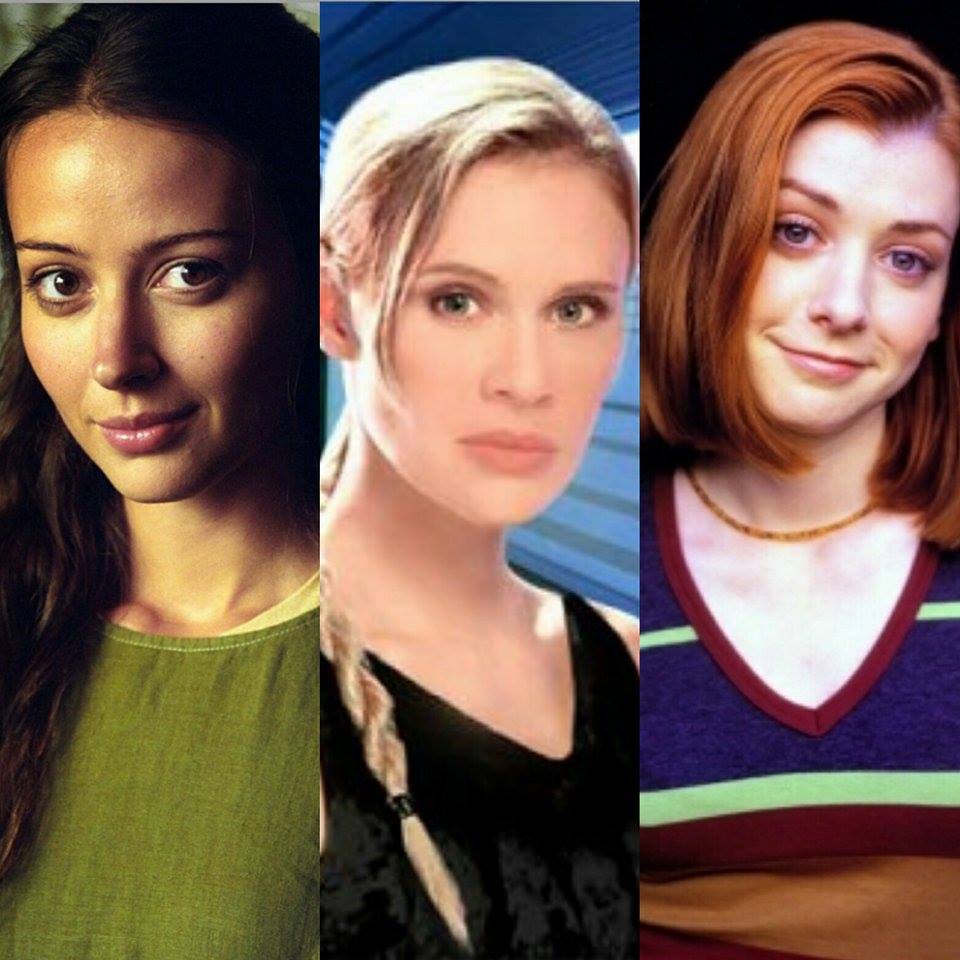
There is a social media challenge going on, "describe yourself in 3 fictional characters." Now, as I pretend/attempt to understand and function in today's social world (I normally fail at this but am getting "better"), I decided to join the masses. I picked my 3 characters with little thought, made up a photo collage, posted it to Instagram and called life good. Here was the finished result:
Everything was great. I had participated in the great social experiment. Perfect. Right?
Not so much.
As soon as I posted the picture I thought, "Well, that isn't right." Because, while these 3 characters describe a par of me, they are hardly the most accurate representation of my personality or life. If they were, my picture would look a lot more like this:
Not so much.
As soon as I posted the picture I thought, "Well, that isn't right." Because, while these 3 characters describe a par of me, they are hardly the most accurate representation of my personality or life. If they were, my picture would look a lot more like this:
Or, maybe like this:
Or this:
Or even this:
There were plenty of more accurate representations that might describe who I am as a person, both in groups and in individual personalities, so why was it that I chose the original 3? What was it about Francie Nolan, Fred Burkle, and Trance Gemini that led to me choosing them to describe who I am?
It is because they are all characters that, while they may not be exactly who I am now, they are characters that best describe the parts of myself that I cherish. They are each a reflection of some part of my best possible self. They all have their demons (some quite literally), but they rose above them, stayed true to themselves, and ultimately, for the most part, managed to remain positive and hopeful.
I am not always like that. I get bogged down under the intensity of life, I dwell on the past. I engage in self-destruction and self sabotage. I battle with my inner demons. I deny myself happiness. I rush into situations. I think too much and not enough. I am sarcastic, pessimistic, and sometimes quite cynical. But despite all these things that I am, it is not who I want to be. It is not the part that I think of when I describe myself.
I want to be positive. I want to see the best in people. I want to trust that people will make decisions for the greater good or have the courage to confront the people who do not. I want to help people, encourage them, believe in them. I want to allow my imagination to run freely. I want to overcome my past. I want to dream big. I want to rely on my friends.
My choices were not reflections of who I am (while I do share traits, there are others with whom I have more in common) but projections of who I wish to be.
Perhaps social media is good for more than just cat pictures after all...
Wednesday, September 21, 2016
A Christian Misconception: Change the narrative
There was recently a
debate brought up on a friend's Facebook page asking members of the LDS Church
to describe why we felt that our religious freedoms are being attacked. The
most common reasons presented in the comments (in support of an attack, anyway)
is because there are currently things present in the world/done by the
government that are contrary to the beliefs and practices of the Church.
Mentioned at one point was an article posted on lds.org labeled, "Why Religious Freedom Matters: What's at Risk." After
reading this article I can understand how people might feel as if there
is an attack on their religion/religious freedom... that is, I can if everyone
dramatizes barely substantiated fears and the realities of living within a
modern non-religious society as much as the author of the article. And so,
today, I shall try to dispel the fears and exaggerations encouraged by the
original article. The initial information will be my opinions of the specific
examples brought up by the article and the latter will be my description
of why Mormons (and Christians as a whole) should not fear that their religious
freedoms are being threatened, at least not in the good old US of A.
"Why Religious
Freedom Matters: What's at Risk"
Now, just starting out
in this article, I am concerned by the language and situation presented.
"Freedom to choose," or "agency," is displayed as being the
most important aspect of the War in Heaven and the language immediately tries
to put a person in the mindset that this freedom is under attack. I disagree.
People are more free to choose (in America) than they have been in the past,
including being free to openly be themselves. It isn't perfect but our freedom
to choose is hardly under threat. The author (whomever it may be) then
transfers into the freedom to practice one's religion "how, when, and where"
they will and makes the claim that this freedom to do so is under attack. I
find it interesting/telling that this concern of attack only comes after there
is disapproval of the Christian faith and is nowhere to be found after similar
(or worse) disapproval of Judaism or Islam (more on this later).
The article brings up 13
"potentially severe consequences" that he/she/it believes may/will occur
if people (note: Mormons or Christians) lose the ability to "worship,
speak, and live" according to their beliefs. I went through each example
and analyzed it for content, truth, or outright exaggeration. The author's
points are in red (main point is bold, qualifiers and examples are in italics).
1.
You
could lose your job or leadership positions for expressing religious
beliefs—even outside of work. The examples given are of people in various professions being
intimidated, fired, or forced to resign due to their beliefs in the
"nuclear" family. I am not saying that these things have not
happened, but it is illegal for any business or job in America to fire you
based on your religious, political, or personal beliefs. If it happens, sue the
company and either get your job back or get money from them breaking the
anti-discriminatory laws. I cannot guarantee that there will not be pressure
from co-workers or management to find another job if your beliefs contradict
the majority of your peers or that you won't be fired for some other reason,
but you cannot be fired solely based on your beliefs. No religious freedom is
being threatened, no one is preventing you from acting in accordance to your
faith.
2.
You
might be required to hide your religion or perform tasks at work that go
against your beliefs. Such as a doctor being forced to perform an abortion or a worker
forced to don an immodest work uniform. First off, welcome to
having a job! If you work in the public sector, where religion has no place,
you might have to set aside personal beliefs/religious practices in order to
continue working. That is life in America if you want to earn money. Your
religion can be a part of your personal life and beliefs but you cannot refuse
to do your job because it interferes with your personal beliefs. If this is a
problem, don't go into a job that might require you to do so. As for the examples,
no doctor can be forced to perform an abortion unless the life of their patient
is at risk (but by denying to perform it the doctor is basically removing the
ability of the woman to exercise her own "freedom to choose"). You
could simply refer your patient to another coworker who will perform the
procedure. The second example is much more straightforward: unless you work for
Hooters, a pool, a bar, or something similar I cannot think of any reason why
an immodest dress code would be enforced. If you do work for one of the former,
why are you complaining, the dress code was probably pretty clear when you got
the job? If you don't, make an internet protest or petition to get the dress
code changed (public awareness/outcry is a potentially beautiful thing for
you). No religious freedom is being threatened, you are simply being held to
the same standards as your co-workers and perform the tasks as a part of your
job description.
3.
You
may be required to work on the Sabbath or religious holidays. First off, see above about having a job. Now,
unless your boss is coming up to you specifically and saying, "You have to
work this day because of your religion," your religious
"freedoms" are not being threatened. It is not illegal for a boss to
require an individual employee to work the days which they are assigned. If it
is a problem, get a different job where your place of business is closed on all
weekends and mainstream religious holidays (this way you will get the Christian
holidays off).
4.
Your
children in public schools may be required to learn about sexual and gender
theories that contradict basic Church teachings. My only response to this is: Good, about time!
The Church places such a high focus on abstinence only sexual education and
creates such a fear and stigma against any form of sexuality that it is no
wonder that the pornography use in Utah is the highest in the country. The
truth is that such approaches to sexual education and conversations is
extremely damaging and can lead to unsafe sexual practices, unintentional
pregnancy, and even emotional disorders. As for teaching differing gender
theories or exposing children to other "sexual" content, either opt
your child out or just accept that not everything in the "real world"
will match the Church's teaching and use this as an opportunity to open a
dialogue with your child. Nothing in this scenario is preventing you from
worshiping or living how you wish, it is not necessary for the entire world to
conform to your ways of life in order to allow you to never be threatened.
5.
You
may not be able to adopt children or become a foster parent. Has this ever actually happened? Honestly,
unless you are adopting through a private religious organization (other than
Mormon) or the birth parents/child have specified the religion they would
prefer their child/themselves to live in. Since adoption is not a right or even
a specific part of religion, this is not an attack on your religious freedom.
(Also, are we not going to mention the families that the LDS adoption agency
have prevented from adopting because of religious beliefs and/or lifestyle or
the times when the US government wouldn't allow gay couples or single parents
to adopt? No? Alright, then.)
6.
As
a business owner or professional, you might lose your license or be fined if
you refuse to perform services that are contrary to your religious beliefs. This is technically true. If you don't perform
the tasks required in your job you could be reprimanded for this refusal. It is
a part of living within a society and having to abide by the standards of the
majority (or even those of the reining political force). Civil protest is
always allowed but there can be repercussions. However, if the organization is
not forcing you to abandon your beliefs entirely, persecuting you specifically
for your beliefs, or forcing you to convert to another set of beliefs then your
religious freedoms are still intact.
7.
You
might not be able to create faith-based clubs on college campuses without being required to let people
become club members—or even officers—who oppose the club’s religious beliefs. The qualifier here does make this statement
true, an official college campus club should be open to any who wish to join
and membership should never be exclusionary. This does not impinge your
religious freedom for others, not of your faith or belief system, to join your
club. They are actually expressing their freedom to choose.
8.
Churches
may be forced to employ people who disagree with or refuse to live core values
of their faith. While not positive, I am
pretty sure that the US government cannot force any religious
institution to hire anyone, as they are not allowed to dictate how religions
are run (unless a myriad of laws are being broken). Even if the Church is forced to
hire people who disagree with the faith (assuming they would even work for a
religious institution to which they were fully opposed), the members would be
relentless in trying to convert them. I am not seeing the threat to religious
freedom in this example.
9.
Churches
could lose their tax-exempt status by maintaining doctrines, policies, and standards that conflict
with secular beliefs regarding marriage, family, gender, and sexuality. This has been a threat for years. It was decreed
before the new LGBTQ legislation and will probably continue to be a large
"threat" hanging over every church until decisions are made about it
(one way or another). However, so long as every religious group loses the
tax-exempt status to the same degree, no religious freedom is threatened
because no religion is being singled out and no one is prevented from
worshiping their religion.
10.
You
might lose tax exemptions for charitable donations like tithes and offerings if the Church loses its status as a
tax-exempt, nonprofit organization. This is a conditional statement that would only come to pass if
the previous statement were true. That being said, so long as tithes and
offerings go to charity, there is no reason that they should suddenly be deemed
ineligible for exemption.
11.
Churches
may not be able to access government lands for camps on equal terms with other
groups. Pay the government for
the use (if required) and I cannot imagine what the problem would be. Seems
like a lot of hassle for the government to suddenly stop allowing any religious
group to use government lands for camps when there are so many different church
groups using them.
12.
Housing
units, such as dorms, at religious colleges could be forced to abandon moral
standards that protect privacy, modesty, and morality. Why would a dorm at a religious college be
forced to abandon moral standards? Firstly, it is a religious college and so,
unless there is illegal activity, the government will allow it to function.
Secondly, so long as the moral standards are not discriminatory (preventing
people from getting an apartment in the first place), no laws
are being broken that would give validity to government involvement. Lastly,
the US government and judges don't seem to care about dorm policies so why are
you even concerned? (And, yes, that last statement was a jab about the way rape
is handled by judges.)
13.
Religious
schools that maintain honor codes may lose their accreditation and be denied
research funds and even federal student loans and grants. Yes, this would be bad... if it were even
remotely likely to happen. Why would an honor code cause a school to lose all
accreditation? So long as the honor code is not requiring students to agree to
break a law and is respecting the property and physical safety of students it
is not illegal.
What you should take
away from all of these examples is that it is the author's attempt at fear
mongering and creating issues where none exist. As phrased, almost every
statement is accurate, all of these things could happen, but the
likelihood of them happening in such a way that it actually threatened
religious freedom is very extremely unlikely. All these scenarios require is
that people co-exist within society, respecting everyone's individual rights
and following the laws and regulations of their jobs and/or schools.
Christianity is the
unofficial official religion of the US. The major holidays are generally
observed, religious items and places of worship are easily located in every
city in every state. (Yes I am including Mormons within the generic wording of
Christianity) Very rarely is a Christian church burned to the ground or
vandalized or defiled. No one is proposing a ban on Christians in the country.
Christians are not randomly set on fire or attacked because of what they wear.
There is a mistaken aura of fear that some Christians have propagated that they
are being persecuted or their rights are being threatened; the scenarios
refuted here are examples of that fear. But many of these same Christians feel
justified in denying the religious rights and safety to others because they
view them as terrorists, cheats, un-American, etc.
If we are truly a
country, if we are truly Christians, that is/are concerned with observing and
continuing the practice of religious freedom then we need to modify our
dialogue. Instead of fearing that the government is going to come in and take
control of all of our churches and limiting our rights, let's work together to
make sure that the rights of other religions are upheld, by the government and
by us. This should be our narrative as followers of Christ, a call for
acceptance and inclusiveness, not a call of fear and division.
Change the narrative.
Monday, September 19, 2016
Why I play "this or that"
Anyone who spends any amount of time with my family will find an interesting dynamic among us. My mom and I will debate random things (probably only half listening to the other at times), my mom and siblings will talk easily about things of no consequence and argue about things that matter (finding out "what happened at school today" is like pulling teeth but my sister will talk endlessly about her friends and teachers), my sister and I talk about a variety of things (from boys and fashion to the odd theological or political discussion), my siblings either bicker or help each other with homework, and my brother and I play a game, specifically, "This or That". Now, this is not to say that we do not also have normal familial conversations about dinner, work, school, and general interests, but the bulk of each individuals' conversation with the others follows these patterns. Most all of us interact like a normal family would (I assume) but my brother and I with our game.
See, my brother is shy and doesn't always like to talk about things like his feelings, likes, or dislikes. What he does like is television (and is beginning to like a few specific books in specific genres). Now, because he is shy, when he was younger much of his communication came by way of "20 questions", where he made short answers and offered no information otherwise. One day recently I decided to change the game a bit. After dragging out information about him, I began to ask about his likes or dislikes by way of television shows, characters, or actors always phrased as such, "do you like ____ or ____?" and he would answer. At first the answers were as short as the 20-question answers, but over time, they became longer and more thought out. Eventually, he became the one positing questions and his shyness and reticence at home began to diminish. Here is what an average game of "This or That" looks like (when he directs it):
Brother: Do you prefer Charlie as FBI or Anya and Andrew in the bathroom in Buffy?
Me: Anya and Andrew
Brother: Root shooting 2 guns or Shaw in "Razgover"?
Me: Shaw.
Brother: Who would win, Shaw or Illyria?
Me: Illyria.
Brother: Amy Acker or Misha Collins?
Me: Amy Acker.
Brother: Fred or Root?
Me: Both.
Brother: Why?
Me: Because they are such different characters that show the range of Amy's acting and I can't choose between them.
Brother: Okay. Charlie or Anya?
Me: Anya. Clara's death or Donna forgetting everything?
Brother: Clara's death.
Me: Why?
Brother: Because Donna forgetting everything was so much sadder because she did such wonderful stuff and she forgot it all.
Me: Who's your favorite Doctor?
Brother: David Tennant.
(As you can tell he loves Joss Whedon and Whedon characters and science fiction as much as I do. The game has also included various tv couples, buzzfeed videos and people, the Daily Show, Colbert, Last Week Tonight, and Cat pictures vs people/tv characters. Although admittedly, the majority of the game is played by comparing various Amy Acker/Felicia Day/Misha Collins/David Tennant characters or scenes because he knows that it is hard for me to choose between them.)
Now, as opposed to before the game began, our interactions have become (for the most part) more interactive and positive. Because we play our game (which is often spitfire and stream of thought), our interactions have become more positive, frequent, and are slowly becoming more expressive and expansive. The game began with single word answers and long awkward pauses and now involves quick questions intermixed with descriptions and discussions. When asked, my brother said that the game helps him know himself and other people's emotions and thought processes (Awesomeness!).
The moral of this post: My brother and I are weird and have a constant game of this or that going that can last for hours, beginning and ending on a whim. Be weird. Do what works for you. Do what helps your family. Have fun. Never conform to societal expectations unless you have to.
Cavemen vs Astronauts
It is no secret that I love Joss Whedon (shows, characters, movies, etc) and am a huge fan of Amy Acker as well. So, of course, one of my absolute favorite characters in any Joss show is Fred Burkle. My brother jokes that I have seen the major Fred episodes of Angel way too often and comments that it is rather sad (seeing as I can quote most of these episodes from memory, I suppose that I can see where he is coming from in that). I probably watch at least 1 Joss episode a week and can relate scenarios in various shows to my life, more often than not. I tell you this as a qualifying preamble to this sudden realization (which did occur at 1:30am while cruising through Pinterest due to insomnia) so that you understand how often I think about Joss' plots and characters.
Now, this morning/night, going through various memes on Pinterest (because that is what it is really meant for) I came across this picture of Spike and Angel:
and I suddenly had an epiphany. I always knew that there was something greater with that seemingly random plot in the episode. I knew that it was important (especially when Fred, on her deathbed mourns to Wesley that the "cavemen always win") but I could never come up with an adequate explanation as to why it was important. This morning I finally understood: the debate as to whether the caveman or astronaut would win in combat is a representation to the audience of the fight between Fred and Illyria. Now, once I came to that realization I began beating myself up because it is so obvious. How could I have missed this before? (I realize that I probably missed it because every time I watch "A Whole in the World" I just cry and both praise and curse Joss.)
This insomnia driven realization now makes the plot of this episode more cohesive, depressing, and beautiful (and thus it continues to be nearly perfect, despite its sadness). Looking now at the plot and dialogue, it becomes so clear that Fred was the astronaut. she was the brainy scientist who was fighting for her life against the caveman, Illyria. This just makes Fred's scene in the lab that much more empowering and her scene in the bedroom that much more depressing. In the former, she is fighting for her life, battling Illyria (which at the time they all think is some weird demon sickness), determined to win. In the latter, where she admits that "cavemen always win," she is admitting defeat, essentially giving up the fight, giving in, admitting defeat, the astronaut stripped of all resources and bowing down to the caveman for death.
Thank you, Joss, for writing such breathtaking characters and plots where I can always find something new to make me love the story even more. I will now have to rewatch the episode (again) to pick up all the mentions of the not-quite-a-sub-plot sub-plot. Perhaps later today... after I've gotten some sleep.
(Disclaimer: pictures and compilation aren't mine.)
Friday, September 2, 2016
An Open Letter to Anonymous Donors
We know you’re out there. We may not know your name or
what exactly you look like but you are no secret to us. Years ago, you made a
decision to change our lives, to begin our lives, and for that, in the end, we
must thank you. Our thanks doesn’t mean we have to love you. Unfortunately, your
choice to be anonymous have affected our lives, the lives you are a part of, in
ways you could not have imagined.
I am sure at the time you weren’t thinking of the
future when the child you could potentially help create would be an adult, a
person, with desires of their own. Or perhaps you were told that being
anonymous is better or you didn’t want to burden your future family with the
knowledge of your decisions. Whatever your reasons for choosing to not be known
to us, they don’t matter now. All that matters now is that you come out because
we are waiting.
I am sure you’ve seen the stories (or at least heard
of them) of how, because of the proliferation of DNA tests, sperm donation is
no longer anonymous. We are searching for you. Eventually, we might find you so
here is your chance. The world is changing, slowly, and secrets are becoming
less common, less necessary, as acceptance struggles to the surface. I urge you
to embrace the change. Let your secrets out. Reveal yourself to us, your
children. We are no longer hiding in the shadows and waiting for you, we are
out in the open, searching the faces of those around us. Searching for you.
Come out to us. Make yourselves known. Use the tools
of our modern society, come onto Twitter and Facebook, test your DNA with
Ancestry or 23andme. Find us because we are waiting. We have questions that
only you can answer so come out and answer them for us, for you. We may not all
be happy with you, we may not all like you, but we do all want to know you, to
see you.
Our very existence proves that your choices exist, so
come out and meet us, the consequences and results of your decisions. We’re
waiting.
Sincerely,
The Anonymous Donor Conceived Community*
(*Disclaimer: I do not presume to speak for the entire donor conceived community, I took some creative licenses while writing.)
Subscribe to:
Posts (Atom)